
Connections
The world is small and history is close

Each week I’ve been charting the progress of getting A Dairy Story out into the world, sometimes that progress feels as though it has real momentum, at other times it feels like there’s a pause, and pauses are ok because it gives time to reflect.
On this final day of May, I wanted to take a moment to reflect on some of the odd connections that have started emerging between the film and my day-job interests. Much of my working life sits at the intersection of food, land, community and communication, so perhaps those connections shouldn’t be surprising in the slightest, yet they are.
Two and a half centuries and 30 miles apart
Rainton Farm, where A Dairy Story was filmed, and Ellisland Farm, where Robert Burns farmed from 1788, are less than thirty miles apart as the crow flies. I was at Ellisland earlier this week and tried to film a red kite soaring above the fields on my phone for an Instagram reel. It was too high up and what I caught was not usable for anything much at all, but it was a lovely moment.
After being wiped out in Scotland in the nineteenth century, red kites are thriving now in Dumfries & Galloway. They would have been a familiar bird to Burns, and I suspect he also saw red kites above Ellisland because he referenced them using the Scots name for them ‘gled’ in his reworking of the Jacobite song Killiecrankie, which he worked on while living at Ellisland in 1790.
I realised later that there is an almost identical scene to the one I saw at Ellisland in our film; a red kite soaring above a field while grass is being cut. And in hindsight it’s no wonder it was difficult to catch on my phone, because it was pushing at the boundaries of Ian’s camera to catch it properly for the film - but he did catch it and did so beautifully.
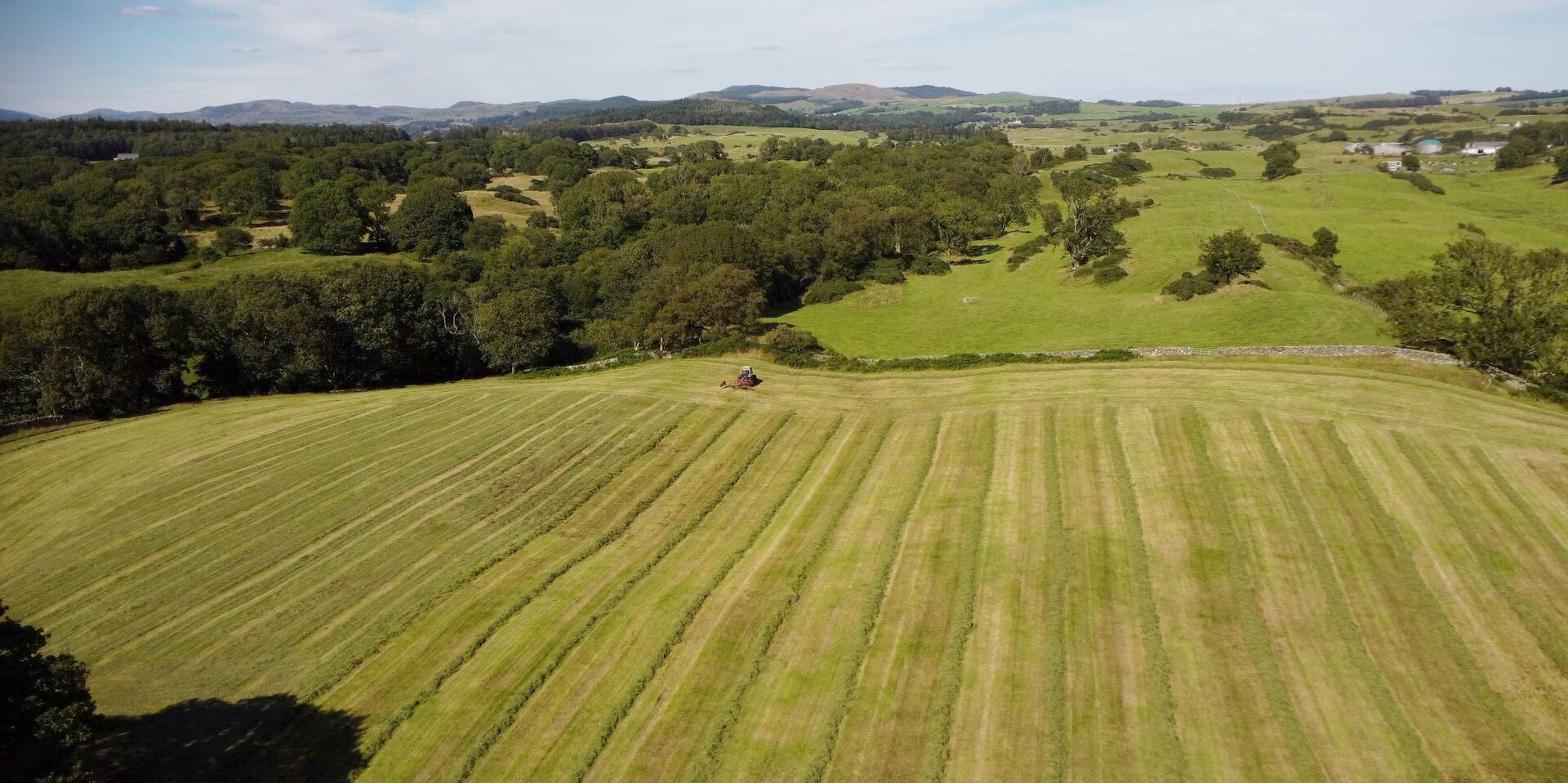
Burns was a pioneering farmer in his time. It’s thought that he introduced the Ayrshire breed of cattle to Dumfries & Galloway, a practical innovation from a man working hard to make his farm viable, bending nature to his needs where he could. David Finlay, thirty miles away and two and a half centuries later, built a system designed around nature, keeping calves with their mothers, long committed to organic, and letting the land and nature lead. Two dairy farmers with the same birds overhead, both paying close attention to the natural world they were working in.
Another connection I’ve just realised is that the farm Burns left to move to Ellisland, was Mossgiel Farm in Ayrshire. That farm is also run by a pioneering farmer, and it’s Scotland’s other commercial, organic cow-with-calf dairy farm.
On taking a stand
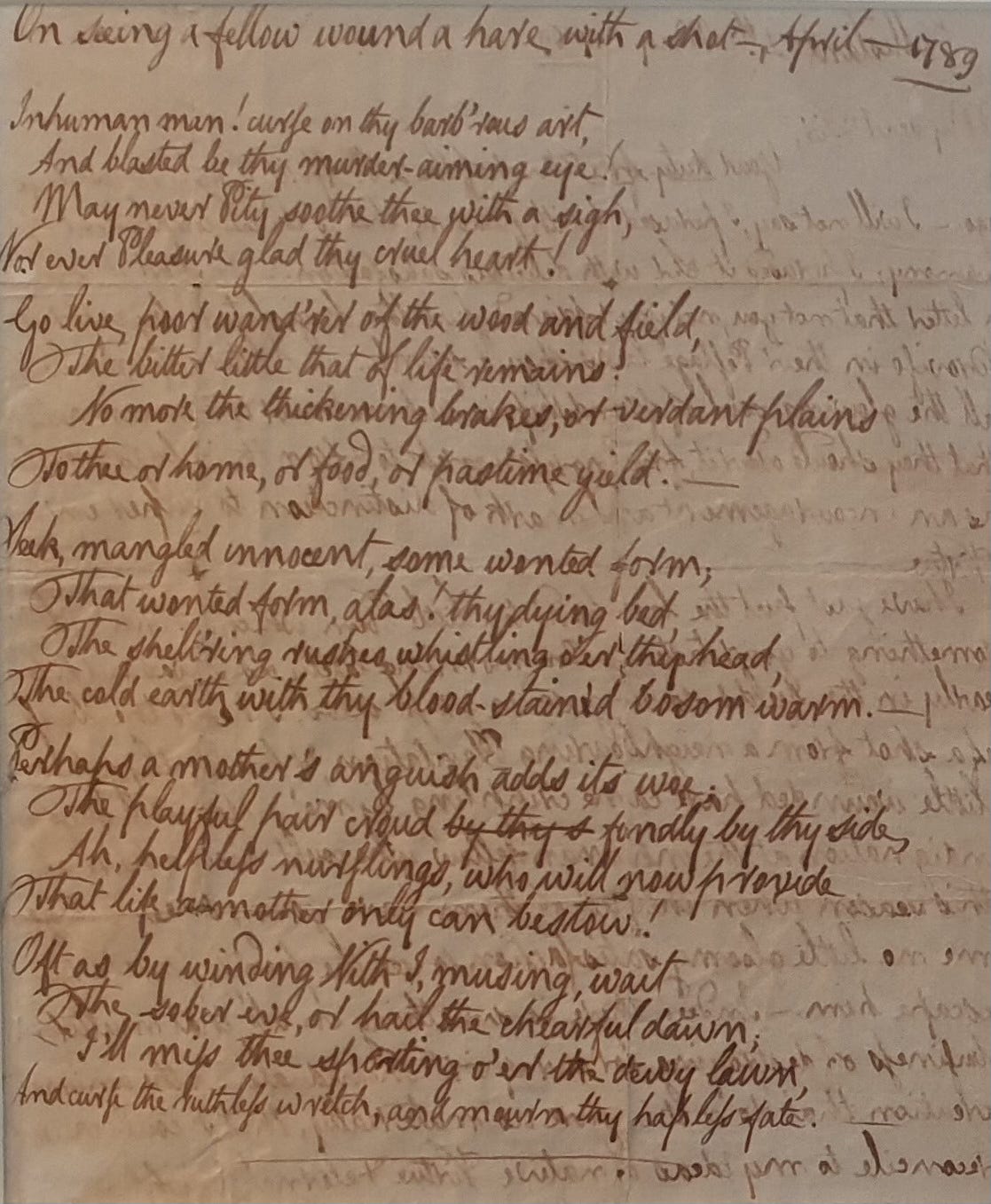
Burns wrote what is thought to be the world’s first anti-bloodsports poem at Ellisland. The Wounded Hare was prompted by seeing a hare shot for sport and fatally injured, it’s beautiful but also very sad.
Inhuman man! curse on thy barb’rous art,
And blasted be thy murder-aiming eye;
May never pity soothe thee with a sigh,
Nor ever pleasure glad thy cruel heart!Go live, poor wand’rer of the wood and field!
The bitter little that of life remains:
No more the thickening brakes and verdant plains
To thee shall home, or food, or pastime yield.Seek, mangled wretch, some place of wonted rest,
No more of rest, but now thy dying bed!
The sheltering rushes whistling o’er thy head,
The cold earth with thy bloody bosom prest.Oft as by winding Nith I, musing, wait
The sober eve, or hail the cheerful dawn,
I’ll miss thee sporting o’er the dewy lawn,
And curse the ruffian’s aim, and mourn thy hapless fate.
The poem was mentioned in TV coverage of Ellisland this weekend, when farming influencer and TV presenter Cammy Wilson (The Sheep Game) visited Ellisland and met Curator, Adam Dickson for an episode of BBC Landward. They spoke about the hare while looking at the original manuscript in Burns’s own hand, Adam said written when Burns is “devastated, but he’s not only devastated; he’s raging”.
Deep connection with nature is something I hope we have conveyed because that same quality of attention runs through everything David does at Rainton. One of the film’s quiet themes is nature thriving alongside the farm, and the farmers’ respect for wildlife, including the predators on the land, because every animal has a role to play in balancing a nature-based system.
Now and again at screenings of the film we notice gasps at scenes containing a fox and a badger, these predators are disliked on many farms, but both these creatures do really important jobs - specifically, they keep the rabbit population at a sensible level. Rabbits eat pasture, after all, and David reckons the healthy population of badgers on his farm has given him a five percent increase in productivity.
The Iowa connection
Earlier this month, a group of academics from Glasgow University was visiting Ellisland. I’d gone along to take a quick photo of the group, but it was such an interesting visit, and such a beautiful day, that I stayed for hours and joined a long walk around the boundaries of the farm.
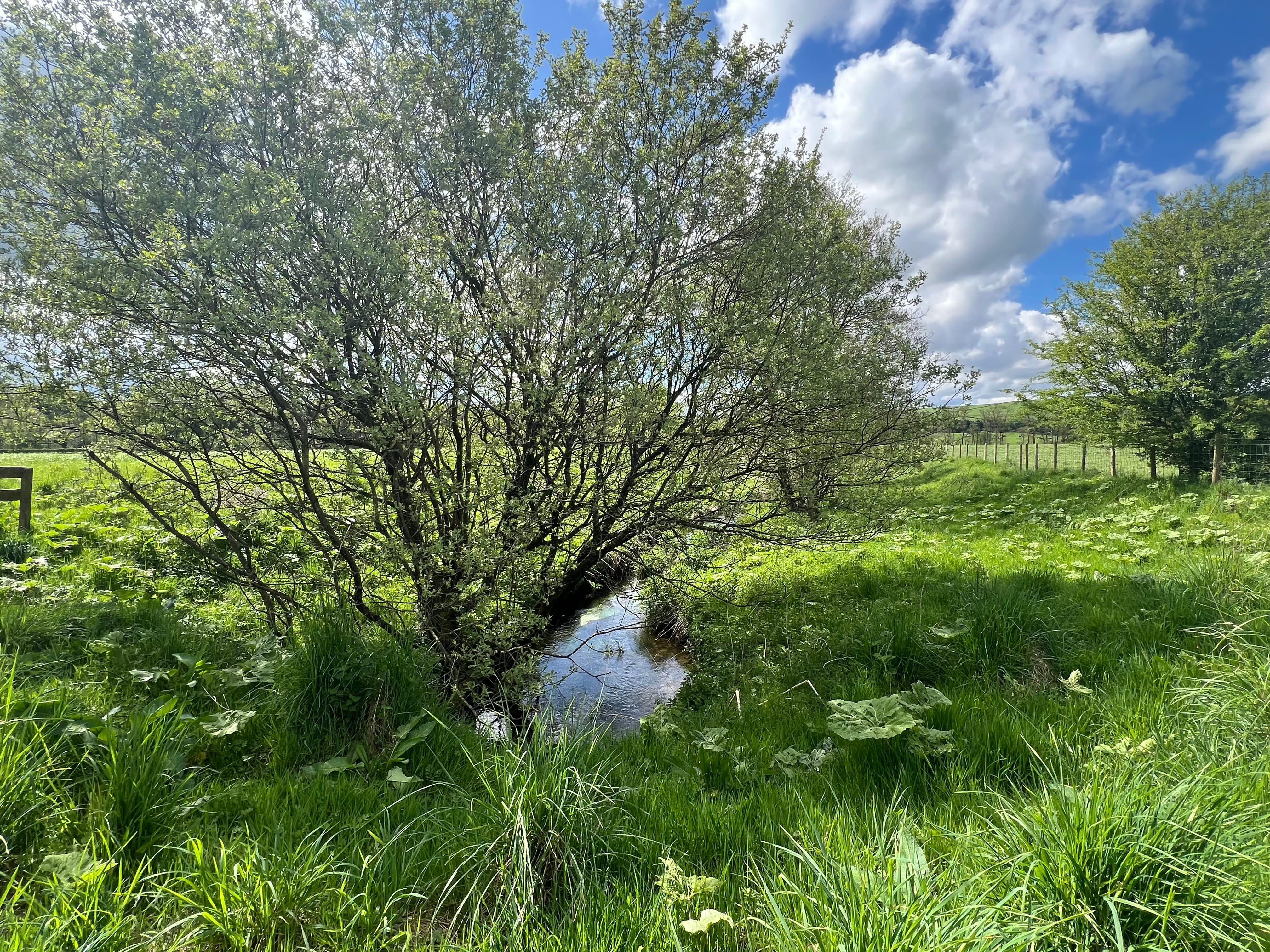
During that walk we saw a red kite and a hare, the entrance to a large badger set, and a deer that came bounding out of a small area of woodland right in front of us.
At some point during the walk I fell into conversation with a woman whose husband was one of the visiting academics. In fact, he’s a professor of environmental literary studies at the University of Iowa.
I mentioned, in passing, that I was involved in a film project and that the film had screened just a few days previously in Iowa. She asked where. It turns out our Iowa film festival screening was only thirty minutes from their home, but of course, they weren’t there, they were traveling. Their trip brought them to Ellisland, exploring European environmental communication, with a specific interest in regenerative farming. There were many, many dots that were joined in that fascinating afternoon, and we have stayed in touch.
I don’t think there’s a tidy lesson in any of this other than the world is small, history only a moment ago, and when there are shared values or interests, connections emerge. That our film keeps finding people who are already thinking about land, nature and animal welfare feels less like marketing and more like serendipity.
I have a funny feeling that this is how A Dairy Story will gradually find its audience, not through aggressive marketing and promotion but through connection, coincidence and shared values.
Lorna
Always inspiring and informative.